Blog

  • What Is Included in the 11+ Exam? Maths, Verbal & Non-Verbal Reasoning Explained

    What Is Included in the 11+ Exam? Maths, Verbal & Non-Verbal Reasoning Explained

    If you’re beginning to look into the 11+ for your child, one of your first questions will probably be:

    What is actually in the exam?

    The answer depends on the school and assessment provider your child is applying to.

    For families in Chester and the Wirral considering one of the four non-faith Wirral grammar schools, the current assessment is provided by Quest Assessments.

    For September 2027 entry, Wirral Council confirms that children take two papers on the same day, covering:

    • Verbal Reasoning
    • Non-Verbal Reasoning
    • Mathematics

    The papers are timed and use multiple-choice questions.

    Here’s what each of those areas actually means.

    What is Verbal Reasoning?

    Verbal Reasoning tests a child’s ability to understand, analyse and work with written information.

    Rather than simply testing whether a child can spell or write well, verbal reasoning requires them to identify relationships and patterns within language.

    Questions might involve skills such as:

    • Identifying relationships between words
    • Understanding synonyms and antonyms
    • Recognising patterns
    • Applying logic to written information
    • Completing word sequences
    • Understanding vocabulary
    • Following written instructions accurately

    Children with a broad vocabulary often have an advantage because unfamiliar words can make otherwise straightforward reasoning questions considerably more difficult.

    This is one reason we encourage families to build vocabulary gradually rather than leaving it until Year 5.

    Why is vocabulary so important?

    Vocabulary isn’t something that can easily be crammed in the weeks before an assessment.

    Children need repeated exposure to words in order to understand them confidently and recognise how they are used.

    At OwlPath, vocabulary development forms part of our wider 11+ preparation.

    Our Vocabulary Mastery programme can also be used alongside tutoring.

    It contains more than 500 words from the Quest Assessments vocabulary list, with children completing short daily missions and revisiting words they have previously found difficult.

    This means vocabulary can develop little and often between weekly tutoring sessions.

    What is Non-Verbal Reasoning?

    Non-Verbal Reasoning tests a child’s ability to recognise patterns and relationships using visual information rather than words.

    Children might need to identify:

    • Which shape comes next in a sequence
    • How a shape has changed
    • Which image doesn’t belong
    • Relationships between shapes
    • Rotations and reflections
    • Visual patterns or rules

    These types of questions can initially feel very unfamiliar.

    The good news is that children can learn strategies for approaching them.

    Rather than simply guessing what “looks right”, students can be taught to systematically look for changes involving:

    • Shape
    • Position
    • Number
    • Rotation
    • Direction
    • Shading
    • Size

    Once children know what they are looking for, seemingly complicated questions often become much more manageable.

    What Maths is included in the 11+?

    11+ Maths is not simply about being able to complete calculations quickly.

    Children need strong mathematical foundations, but they also need to be able to apply their knowledge to unfamiliar problems.

    Preparation may involve areas such as:

    • Addition, subtraction, multiplication and division
    • Fractions, decimals and percentages
    • Measurement
    • Time
    • Money
    • Geometry
    • Number patterns
    • Problem solving
    • Multi-step questions

    As children move closer to the assessment, they also need to become comfortable choosing an efficient method under timed conditions.

    A student might know exactly how to solve a problem but still lose marks if each question takes too long.

    Where does English fit in?

    Parents sometimes ask why OwlPath assesses English when the current Wirral assessment areas are described as Verbal Reasoning, Non-Verbal Reasoning and Mathematics.

    That’s because strong English skills underpin a significant amount of 11+ learning.

    Reading comprehension and vocabulary can affect how confidently children understand questions, interpret written information and tackle verbal reasoning.

    Some independent school entrance assessments also have different structures and may include more explicit English components.

    OwlPath tutors have experience working with Quest, GL Assessment, CEM and ISEB-style assessments, so preparation can be adapted to the schools a child is considering.

    Do children need to practise all three subjects equally?

    Not necessarily.

    This is one of the reasons we don’t recommend starting an 11+ programme by simply buying three workbooks and completing the same amount from each.

    Every child has different strengths.

    For example:

    Child A may be working significantly above their age in Maths but have a relatively limited vocabulary.

    Child B may be an excellent reader but find Non-Verbal Reasoning completely unfamiliar.

    Child C might understand all three areas but work too slowly when timed.

    Those children shouldn’t receive identical preparation.

    How does OwlPath identify what a child needs?

    Every new OwlPath 11+ student begins with a free 30-minute diagnostic assessment.

    We assess:

    • English
    • Maths
    • Verbal Reasoning
    • Non-Verbal Reasoning

    Parents receive a score out of 10 for each area, alongside a more detailed breakdown of individual skills.

    We then create a personalised study roadmap.

    After the assessment, parents have a free consultation with their child’s tutor to discuss the results and decide on the appropriate programme, format and areas of focus.

    Building towards exam conditions

    Learning the content comes first.

    But eventually, children also need to be able to apply those skills under examination conditions.

    That means gradually introducing:

    • Timed questions
    • Time management
    • Multiple-choice strategies
    • Answer-sheet familiarity
    • Working through difficult questions without becoming stuck
    • Mock examinations

    For the current Wirral test, official familiarisation material confirms that children work through timed multiple-choice papers and record responses on a separate answer sheet.

    Becoming familiar with that process before exam day means the format itself doesn’t have to be completely new.

    Preparing for the 11+ in Chester and the Wirral

    OwlPath provides 11+ tutoring for children in Years 3, 4 and 5 across Chester and the Wirral.

    Rather than starting with a generic programme, we begin by finding out exactly where your child is now.

    Book a free OwlPath 11+ Diagnostic Assessment to discover your child’s strengths, gaps and recommended next steps.
  • 11+ Tutoring in Chester: What Should Parents Look For?

    11+ Tutoring in Chester: What Should Parents Look For?

    If you’re searching for 11+ tutoring in Chester, you will quickly discover that there are plenty of options.

    One-to-one tutors. Large tuition centres. Online courses. Practice-paper subscriptions. Small groups.

    So how do you decide which one will actually suit your child?

    The most important thing is not simply finding someone who can teach 11+ questions.

    Effective preparation should identify where your child is now, what they need to improve and whether they are actually progressing over time.

    Here are some of the things we think parents should consider.

    1. Does the tutor understand the schools your child is applying to?

    The phrase “11+” covers many different entrance assessments.

    A tutor preparing children for schools in another part of the country may be working towards a very different format.

    For families in Chester considering Wirral grammar schools, this is particularly relevant because the non-faith Wirral grammar schools have recently moved to Quest Assessments.

    Other independent schools can use different formats.

    Ask potential tutors which assessment providers and schools they are familiar with.

    OwlPath tutors have experience with Quest, GL Assessment, CEM and ISEB, but our 11+ service is specifically focused on families in Chester and the Wirral.

    2. Do they assess your child before tutoring begins?

    A good tutor shouldn’t need several months of lessons to discover that your child struggles with fractions or has an excellent vocabulary.

    Ideally, there should be some form of baseline assessment before a programme begins.

    Every OwlPath 11+ student starts with a free 30-minute diagnostic assessment covering:

    • English
    • Maths
    • Verbal reasoning
    • Non-verbal reasoning

    Parents receive a score out of 10 in each area as well as a detailed skills breakdown.

    The tutor can then create a personalised roadmap based on the results.

    This means the first lesson already has direction.

    3. Is the programme personalised?

    Two Year 5 children preparing for the same assessment can need completely different support.

    One may have excellent reasoning skills but weaker maths fundamentals.

    Another may be academically strong but struggle badly when timed.

    A third may need substantial vocabulary development.

    11+ preparation should adapt to those differences.

    At OwlPath, the initial diagnostic assessment and ongoing assessments are used to determine the areas each student needs to prioritise.

    4. How large are the groups?

    Small-group tutoring can work extremely well for 11+ preparation.

    Children have the opportunity to learn alongside others, discuss approaches and experience a little healthy challenge while still receiving direct attention from the tutor.

    But class size matters.

    An 11+ “group” containing a large number of children can start feeling much more like another school classroom.

    OwlPath’s small-group sessions are limited to a maximum of four students.

    For children who need more individual support, one-to-one tuition is also available.

    5. Can you choose between one-to-one and group tutoring?

    Neither format is automatically better.

    The right choice depends on the child.

    Small-group tutoring may suit children who:

    • Enjoy learning alongside others
    • Are motivated by seeing peers solve problems
    • Benefit from discussion
    • Have relatively similar academic needs to the group

    One-to-one tutoring may suit children who:

    • Have very specific gaps
    • Need to work at a different pace
    • Lack confidence
    • Need intensive support in particular areas
    • Would struggle to concentrate effectively in a group

    This is why OwlPath doesn’t expect parents to choose a format before we have assessed their child.

    The diagnostic assessment is followed by a free tutor consultation, where you can discuss the most appropriate option.

    6. What happens between lessons?

    One hour of tutoring each week is valuable, but children also need opportunities to reinforce what they’ve learned.

    Ask what your child will be expected to do between sessions.

    OwlPath students receive Smart Assignments — structured tasks designed to reinforce the areas covered during tutoring and keep progress moving between lessons.

    The aim isn’t to overwhelm children with homework.

    It is to make home practice more targeted.

    7. How will you know whether your child is progressing?

    Parents shouldn’t have to rely on:

    “They seem to be doing well.”

    Look for a tutoring programme with measurable progress tracking.

    At OwlPath, parents receive progress information through the OwlPath Parent Dashboard, while quarterly assessments provide formal checkpoints throughout the programme.

    This helps tutors answer important questions such as:

    • Which areas have improved?
    • Which skills remain weaker?
    • Has the child’s speed improved?
    • Does the learning plan need adjusting?
    • Is additional support needed as the exam approaches?

    8. Does the programme develop vocabulary?

    Vocabulary is easy to underestimate.

    Children cannot suddenly learn hundreds of unfamiliar words during the final few weeks before an entrance exam.

    It develops much more effectively through regular exposure.

    Alongside our tutoring programmes, OwlPath students can use Vocabulary Mastery, which includes 500+ words from the Quest Assessments vocabulary list.

    Children complete short daily missions, revisit words they find difficult and earn XP as they progress.

    This makes vocabulary development a consistent part of preparation rather than something left until the final months.

    9. Does the tutor prepare children for the experience of the exam?

    Knowledge is only part of 11+ preparation.

    Children also need to know what it feels like to work under examination conditions.

    As the test approaches, preparation should introduce:

    • Timed questions
    • Full sections
    • Exam technique
    • Time management
    • Answer checking
    • Mock assessment conditions

    Familiarity can make the real assessment feel considerably less unfamiliar.

    A child who has already practised managing their time and recovering from difficult questions can approach exam day with much more confidence.

    10. Does your child actually feel comfortable with the tutor?

    Finally, qualifications and resources aren’t everything.

    Your child needs to feel comfortable enough to ask:

    “I don’t understand.”

    A good tutor should be able to identify when a child needs more challenge, when they need something explained differently and when confidence is becoming as important as academic ability.

    For that reason, finding the right relationship between student and tutor matters.

    OwlPath 11+ tutoring in Chester

    OwlPath provides structured 11+ preparation for children in Years 3, 4 and 5 across Chester and the Wirral.

    Our programmes include:

    • Year 3 Foundation
    • Year 4 Foundation
    • Year 5 Advanced
    • One-to-one tutoring
    • Small groups of up to four
    • In-person sessions
    • Online tutoring
    • Smart Assignments
    • Parent progress dashboard
    • Quarterly assessments
    • Vocabulary Mastery
    • Timed and exam-focused preparation

    Children can currently attend in person at our Chester centre, with in-person sessions in the Wirral being introduced, alongside online tuition.

    Most importantly, you don’t have to choose a programme before knowing what your child actually needs.

    Start with a free 11+ Diagnostic Assessment

    Your child’s free assessment measures their current ability across English, Maths, Verbal Reasoning and Non-Verbal Reasoning.

    You’ll then receive a detailed breakdown and personalised learning roadmap before discussing the results with one of our tutors.

    Book your free OwlPath 11+ Diagnostic Assessment and find out exactly where your child should focus next.

  • OwlPath Academy Educational Platform for Parents & Students

    OwlPath Academy Educational Platform for Parents & Students

    Introducing OwlPath Academy’s Educational Platform: See Your Child’s Progress, Lesson by Lesson

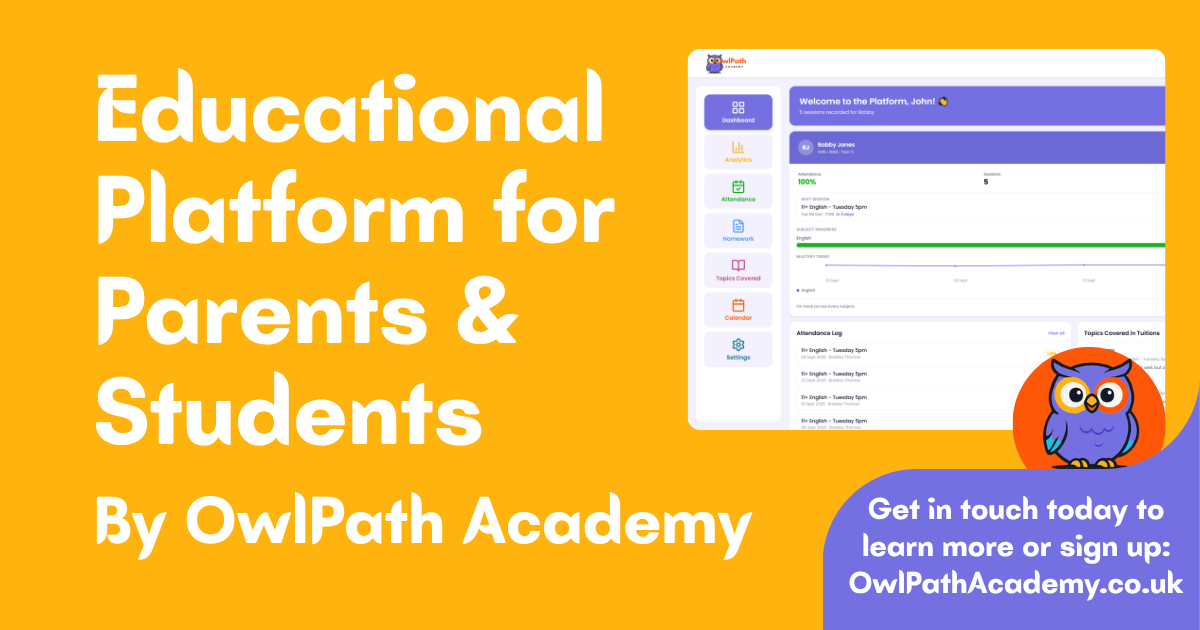
    OwlPath Academy’s educational platform is now live. Every OwlPath family gets a parent dashboard and a student dashboard, so you can see what was taught in each lesson, how your child is getting on and what homework is due.

    When a child has tuition, parents often hear very little about what happens in the lessons. The platform puts that information in one place, so you don’t have to ask.

    OwlPath Academy offers 11+, SATs and GCSE tuition in Wirral, Chester and online, and the platform shows you what is happening in your child’s lessons. This post explains how it works and what parents and students can see. The screenshots use example data.

    How the platform works

    After each lesson, one of our tutors writes it up on the platform. They record who attended, what was taught, how the lesson went, a score for each topic and any homework they have set.

    That record appears on your dashboard. Your child sees the topics covered and the tutor’s feedback on theirs.

    Your child then completes homework and practice questions on their own dashboard. Tutors review their progress and use it to decide which areas need more explanation or practice in future lessons.

    Parents and students each have their own account and their own sign-in.

    What parents can see

    Owlpath Parent Dashboard Overview

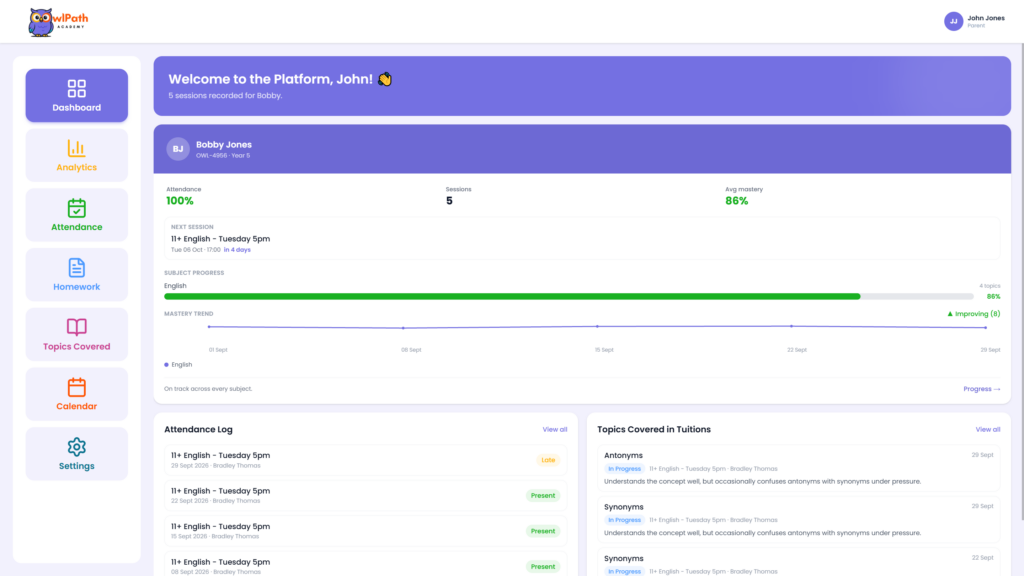
    Your dashboard overview

    Your dashboard opens with a summary for your child. It shows their attendance rate, how many sessions have been recorded, their average mastery score, and when their next session is. Below that you can see progress in each subject, a trend line showing how their scores are changing, and the most recent attendance and topics.

    The mastery score is a percentage for each topic, set by the tutor, showing how well your child has understood it.

    Attendance

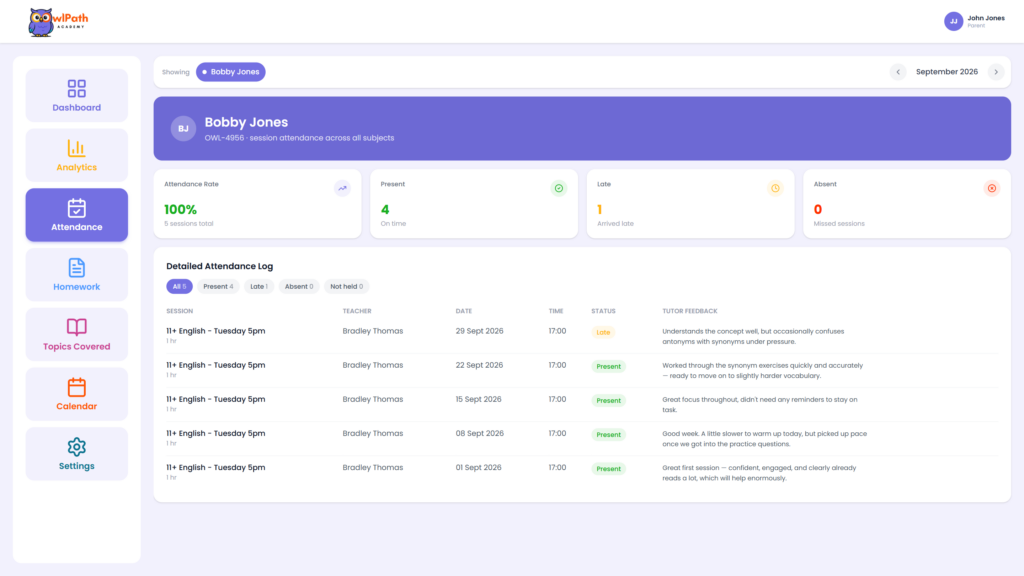
    Owlpath Parent Dashboard Attendance Overview

    The attendance page lists every lesson with its date, time, tutor and status: present, late or absent. Each one includes the tutor’s feedback from that lesson. You can move between months and filter the list by present, late, absent or not held.

    Tutors can also leave notes that are only visible to parents.

    Topics Covered

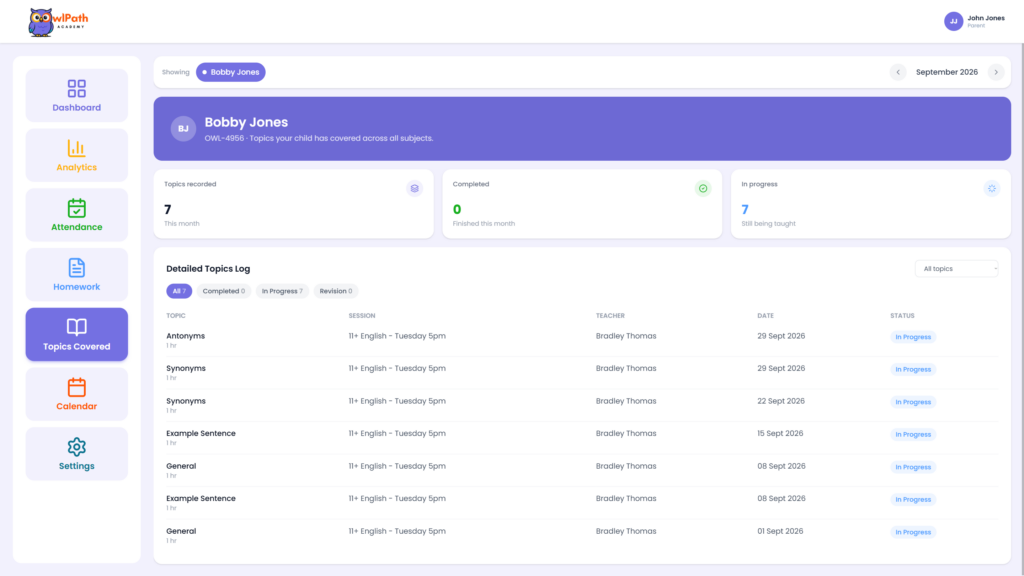
    Owlpath Parent Dashboard Topics Covered

    This page shows what your child has been taught, session by session. Each topic is listed with the session, tutor and date, and is marked as in progress, completed or revision. A summary at the top shows how many topics have been recorded this month and how many are finished.

    Analytics

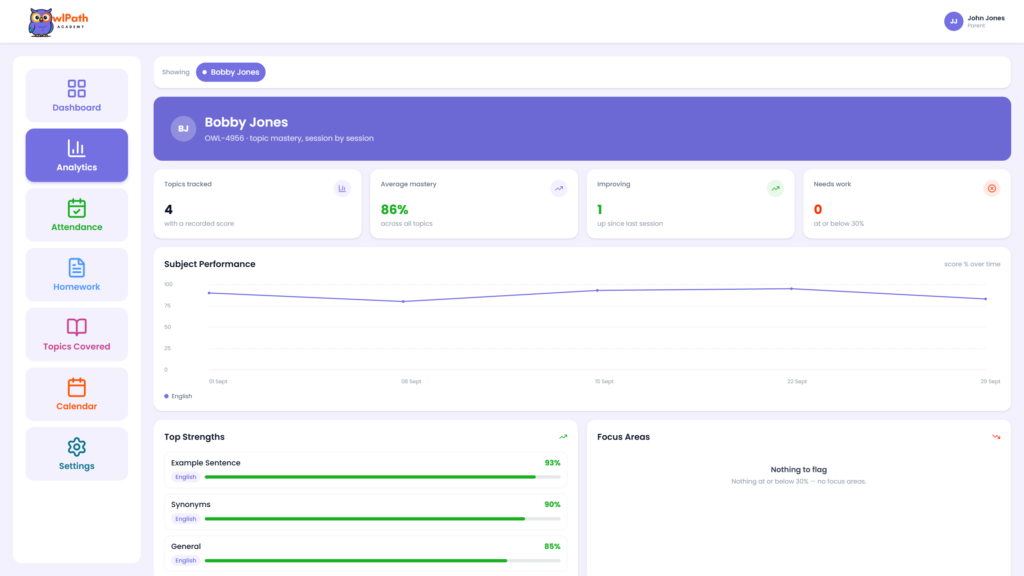
    Owlpath Parent Dashboard Analytics

    Analytics shows how your child is doing in each topic over time. The headline figures are how many topics have a recorded score, their average mastery, how many topics have improved since the last session and how many need work, which means a score of 30% or below.

    A chart shows their scores across sessions. Top Strengths lists the topics they are doing best in, and Focus Areas flags anything that needs attention, so you can see where extra practice would help.

    Homework

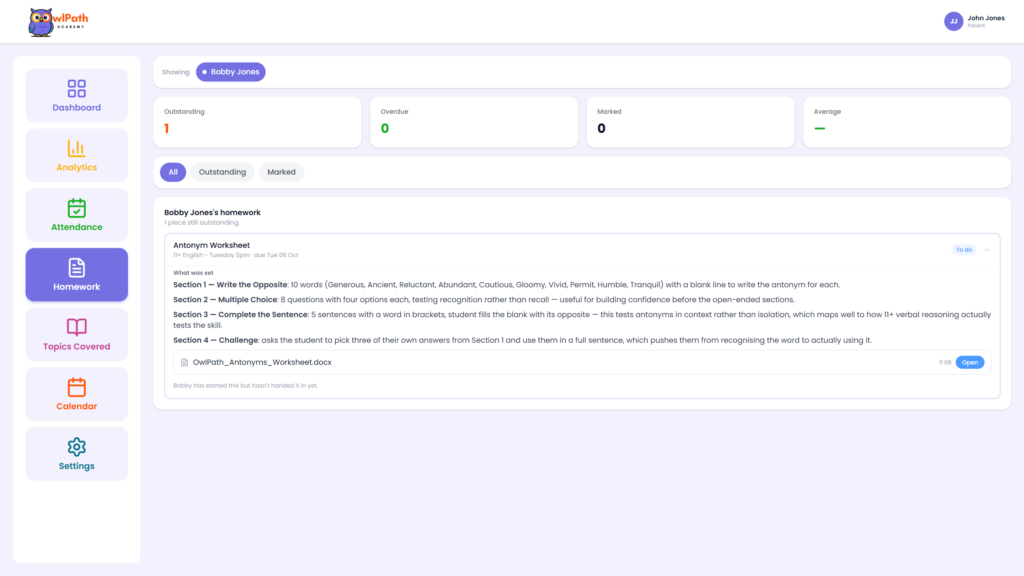
    Owlpath Parent Dashboard Homework Screen

    The homework page shows what the tutor has set, what is outstanding or overdue and what has been marked. Each piece shows the due date, what was set, the worksheet itself, and whether your child has started it or handed it in. Once the tutor has marked it, you can see the score.

    Calendar

    Owlpath Parent Dashboard Calendar

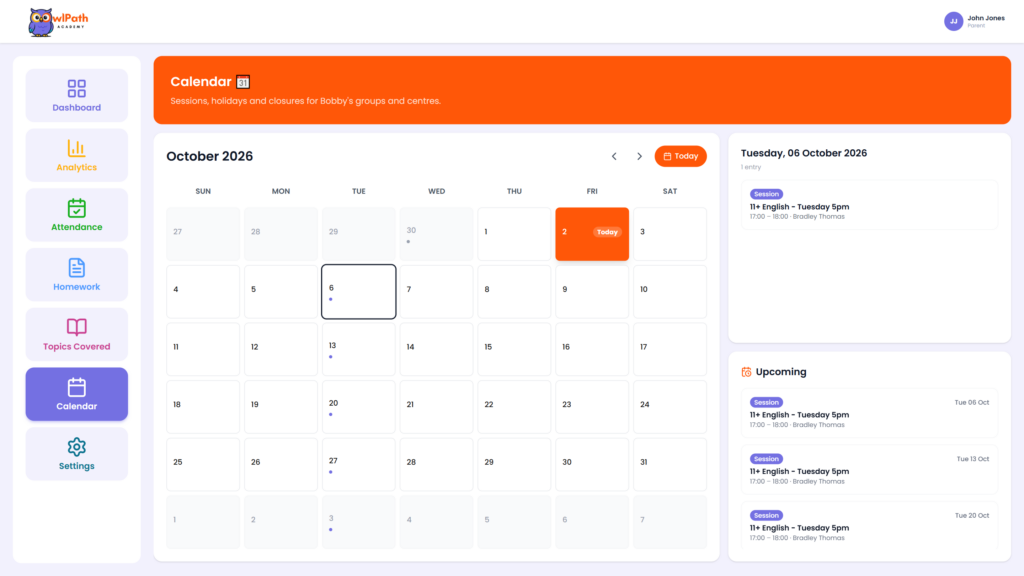
    The calendar shows your child’s upcoming lessons, plus holidays and closures for their group and centre. Select a day to see what is on, or use the upcoming list to see what is next.

    More than one child

    Have more than one child? Each one gets their own dashboard, and you can view them side by side easily, so keeping track of everyone is simple, not a chore.

    What students can see

    Each student has their own dashboard, designed for them. Here is what is on it.

    Owlpath Student Dashboard Overview

    Dashboard

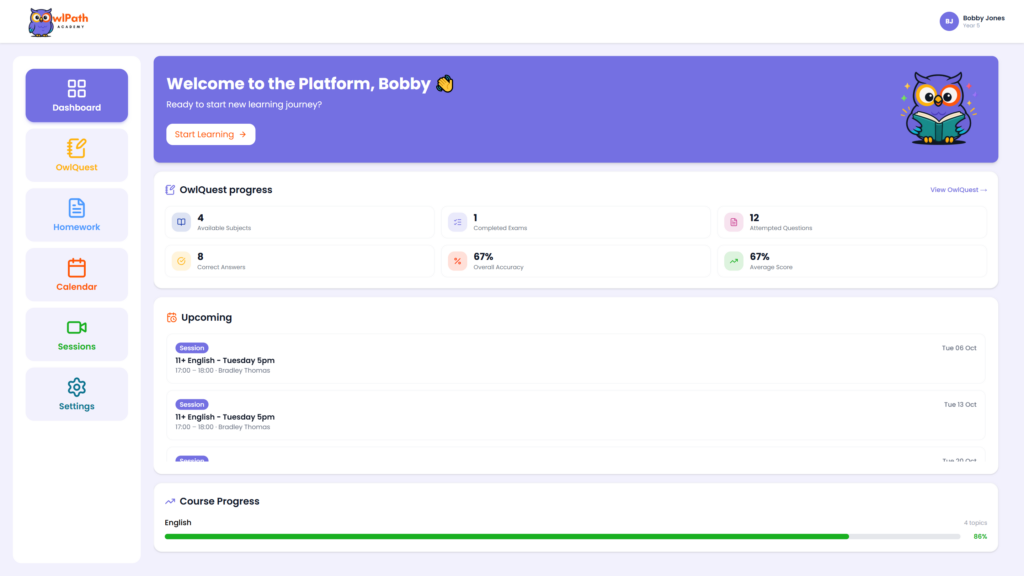
    The student dashboard has a Start Learning button, a summary of their OwlQuest progress, their upcoming sessions and their progress in each subject. The OwlQuest summary shows how many subjects are available, how many exams they have completed, how many questions they have attempted and answered correctly, and their overall accuracy and average score.

    OwlQuest practice

    Owlpath Student Dashboard Owlquest

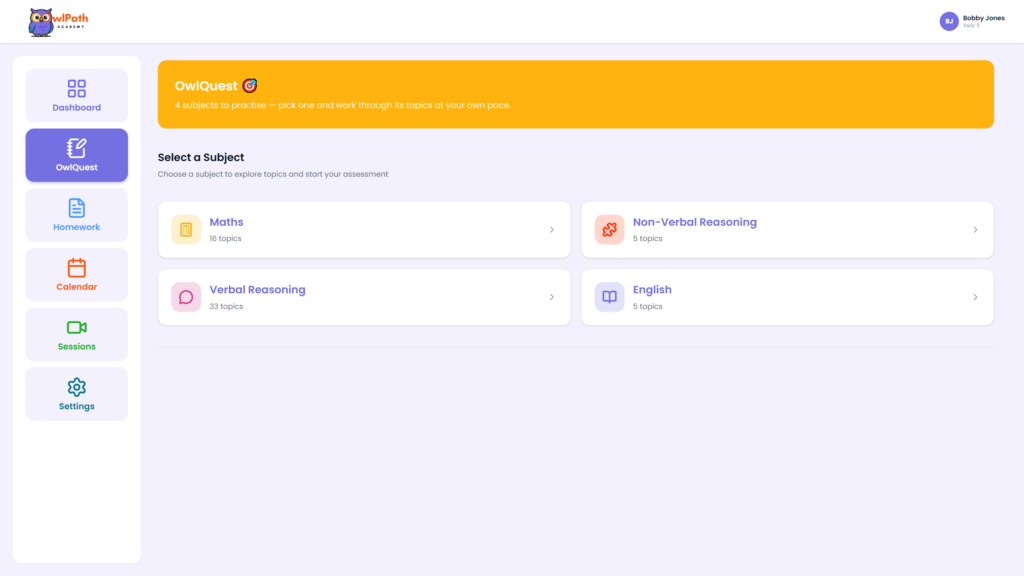
    OwlQuest is where students practise on their own. They choose a subject, such as Maths, Verbal Reasoning, Non-Verbal Reasoning or English, and work through its topics at their own pace.

    Owlquest example question

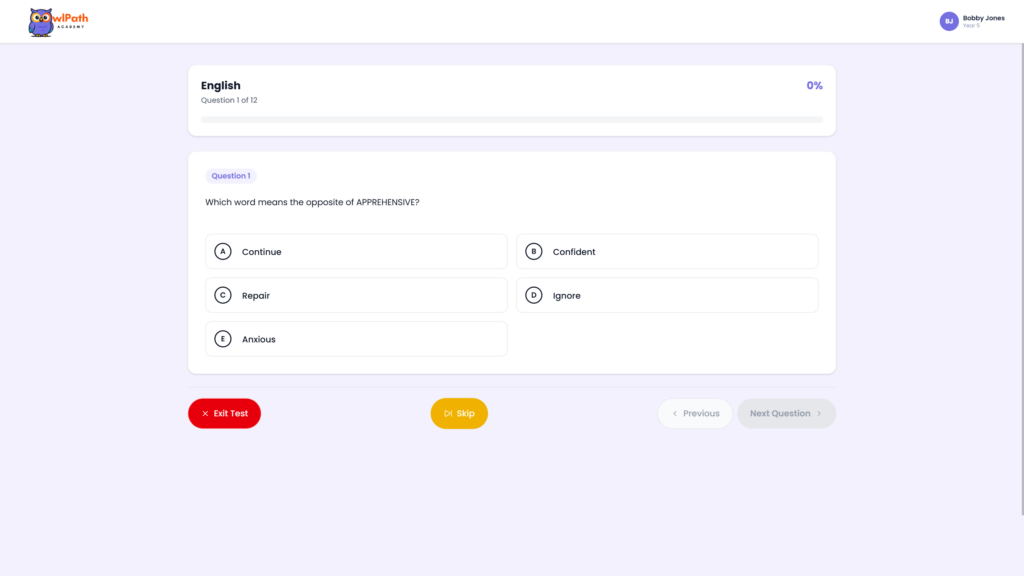
    Questions are multiple choice. Students can skip a question, go back to a previous one or exit the test. OwlQuest also includes mock exams, so students can build up to full papers.

    Homework

    Owlpath Student Dashboard Homework

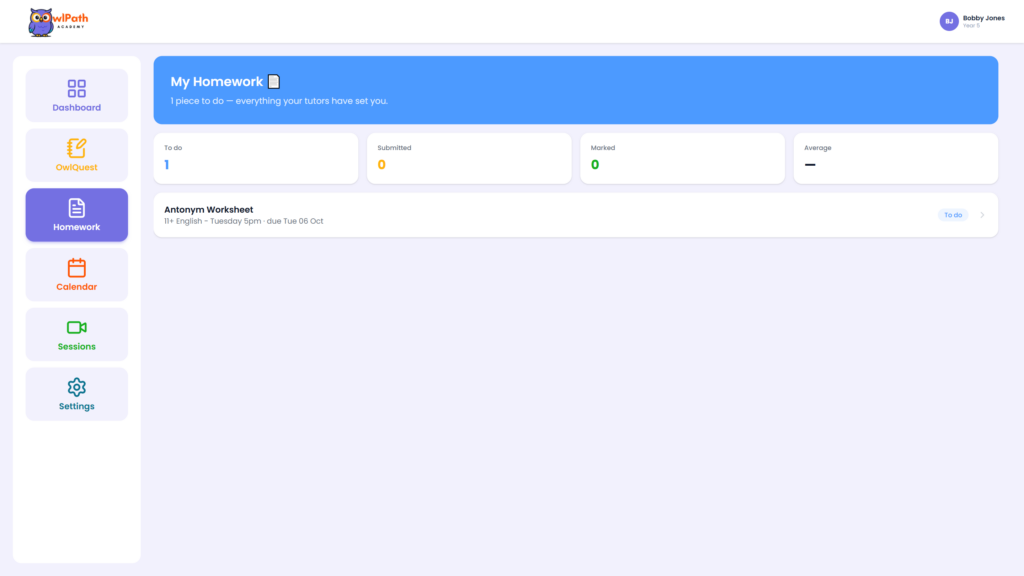
    Everything the tutor has set appears in one list, showing what is to do, submitted and marked, along with an average score.

    Owlpath Student Dashboard Homework Submission

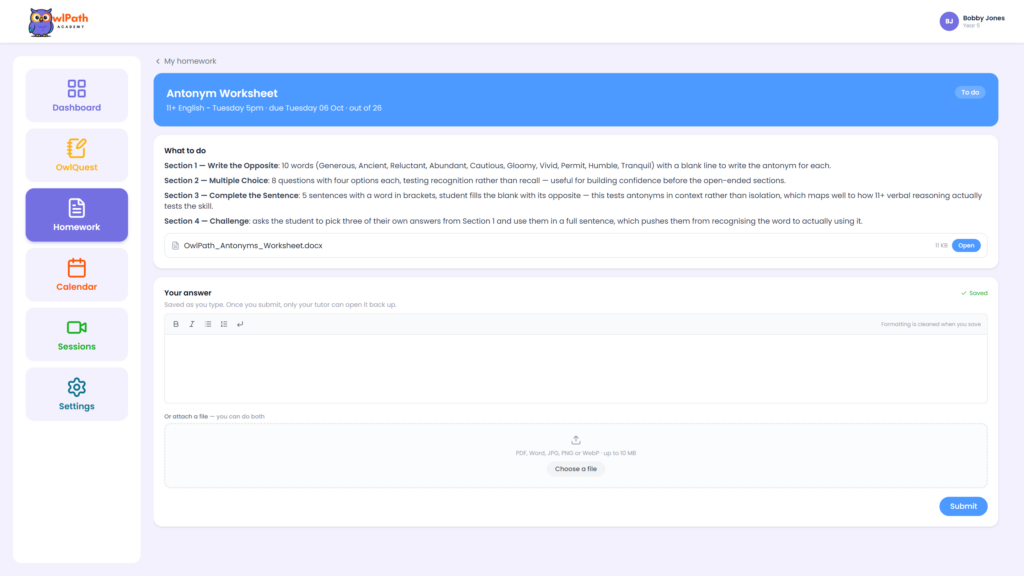
    To complete a piece of homework, your child opens the worksheet, then types their answer on screen, attaches a file, or does both. Files can be PDF, Word, JPG, PNG or WebP, up to 10 MB. Their answer is saved as they type. Once they submit, only their tutor can open it. When the tutor has marked it, the score appears on the dashboard.

    Sessions attended

    Owlpath Student Dashboard Topics Covered

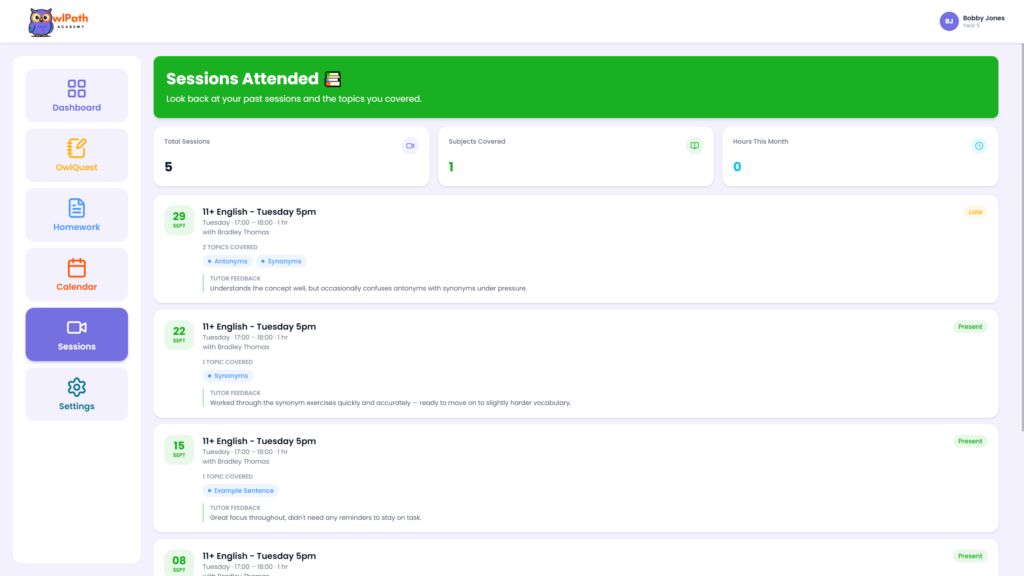
    Students can look back at every lesson they have had. Each one shows the date, tutor, whether they were present or late, the topics covered and the tutor’s feedback.

    Calendar

    Owlpath Student Dashboard Calendar

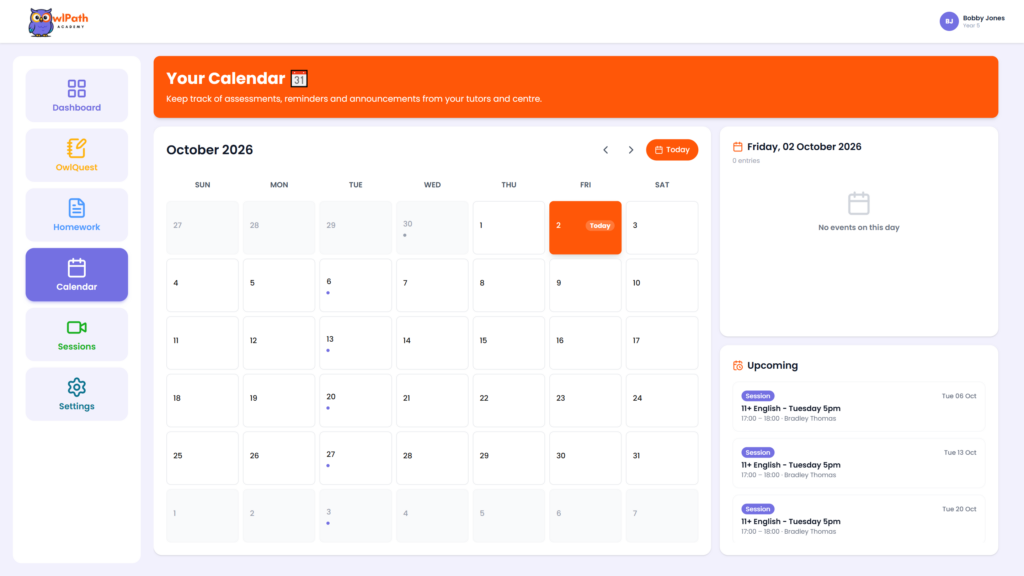
    The student calendar helps them keep track of their lessons, assessments, reminders and announcements from their tutors and centre.

    Frequently asked questions

    Does my child have their own login? Yes. Parents and students each have their own account and their own dashboard.

    What can I see as a parent? You can see your child’s attendance, the topics covered in each lesson, their progress in each topic, their homework and their calendar, along with the tutor’s feedback.

    Can I see more than one child? Yes. Each child has their own dashboard, and you can view them side by side easily, so keeping track of everyone is simple, not a chore.

    What is OwlQuest? OwlQuest is the practice area on the student dashboard. Students choose a subject and work through its topics with multiple-choice questions, and it also includes mock exams.

    How do I get access? Register your child using our registration form. Once the team has set up your accounts, you will receive your sign-in details by email.

    Can I use the platform on my phone? Yes. The platform works on mobile, so parents and students can check in from a phone as well as a computer. It runs in your web browser, so there is nothing to download.

    Get started

    To register your child, fill in our registration form. You can change your password from Settings after you first sign in.

    If you would like to see where your child is now before you decide, they can take our free 11+ assessment. You can also look at our tutoring options or get in touch with any questions.

    Register Your Child Take Free Assessment
  • How Does the Wirral 11+ Work? A Guide for Parents 

    How Does the Wirral 11+ Work? A Guide for Parents 

    If your child is considering a grammar school on the Wirral, the 11+ process can initially seem confusing.

    There are assessment registrations, school applications, different grammar schools and now a relatively new assessment provider to understand.

    Here is a simple overview of how the Wirral 11+ works and what parents should know when preparing their child.

    Which schools use the Wirral 11+?

    The four non-faith Wirral grammar schools work together as a consortium for 11+ testing:

    • Calday Grange Grammar School
    • West Kirby Grammar School
    • Wirral Grammar School for Boys
    • Wirral Grammar School for Girls

    The consortium has moved to Quest Assessments as its test provider.

    Parents should be aware that Upton Hall School FCJ and St Anselm’s College have separate entrance arrangements, so you should always check the admissions information for every school you are considering.

    What is Quest Assessments?

    Quest Assessments provides entrance assessments used by grammar and independent schools.

    Importantly, there isn’t one universal “Quest 11+ paper” used identically by every school.

    The content and structure of a Quest assessment depend on the particular school or consortium.

    For the current Wirral process, parents should therefore use information specifically published for the Wirral grammar school assessment, rather than relying on information about Quest tests used elsewhere.

    What is included in the Wirral 11+?

    For September 2027 secondary school entry, Wirral Council’s published information states that children take two papers on the same day.

    The assessment includes questions covering:

    • Verbal reasoning
    • Non-verbal reasoning
    • Mathematics

    For that admissions cycle, the assessment took place on 15 September 2026.

    The Wirral grammar schools have said that, despite moving to a new provider, they chose to retain the same overall style and format for the first year of the change, including the areas assessed and their relative weighting. They have also advised families to check future admissions information because elements of the assessment can change over time.

    This last point is important.

    If your child is currently in Year 3, Year 4 or Year 5, don’t assume today’s precise test structure will necessarily remain unchanged for their cohort.

    Why does OwlPath also teach English and vocabulary?

    Parents may notice that OwlPath’s 11+ diagnostic assessment covers four areas:

    English, Maths, Verbal Reasoning and Non-Verbal Reasoning.

    There is a reason for this.

    Strong reading, comprehension and vocabulary skills underpin many aspects of selective entrance preparation, particularly verbal reasoning.

    Vocabulary development is therefore an important part of our wider 11+ programme even where an assessment provider does not describe a separate paper simply as “English”.

    It is also particularly useful for children considering independent schools, where entrance assessment structures may differ.

    When do parents register for the Wirral 11+?

    Registration for the selective assessment happens before the normal secondary school preference deadline.

    For September 2027 entry, registration opened in May 2026 and the published deadline was at the end of May/beginning of June. The assessment then took place in September, with results issued before the 31 October secondary school application deadline.

    Dates change each year.

    Parents should therefore check the latest information published by Wirral Council and the individual grammar schools during Year 5.

    This is particularly important for families living in Chester.

    You do not need to live within Wirral to request the assessment. Wirral Grammar School for Boys, for example, specifically states that the assessment request process applies to both Wirral and Cheshire residents.

    Your child’s eventual school application is then made through the relevant local authority for where you live.

    How should a child prepare for the Wirral 11+?

    Successful preparation involves much more than repeatedly completing full papers.

    Children need to develop the underlying skills first.

    That includes:

    Mathematics

    Children should be confident with the relevant primary maths curriculum and increasingly able to apply their knowledge to unfamiliar or multi-step problems.

    Verbal reasoning

    Verbal reasoning involves understanding and manipulating language, identifying patterns and applying logical thinking to words and information.

    Strong vocabulary is particularly helpful here.

    Non-verbal reasoning

    Non-verbal reasoning requires children to identify patterns, relationships and sequences using shapes and visual information.

    These question types can initially feel unfamiliar, so learning how to approach them systematically is important.

    Vocabulary and comprehension

    Even beyond explicitly labelled English questions, strong language skills can help children understand instructions, identify relationships between words and interpret increasingly complex information.

    Timing and exam technique

    A child can understand a question perfectly but still struggle if they spend too long answering it.

    As the assessment approaches, children need opportunities to practise:

    • Working under timed conditions
    • Knowing when to move on
    • Checking answers efficiently
    • Following examination instructions
    • Remaining calm when they encounter a difficult question

    When should Wirral 11+ preparation begin?

    There isn’t one answer for every child.

    At OwlPath, preparation is divided into three stages.

    Year 3 Foundation develops vocabulary, reading, early reasoning and number confidence gradually and without unnecessary examination pressure.

    Year 4 Foundation introduces structured development across Maths, English, Verbal Reasoning and Non-Verbal Reasoning.

    Year 5 Advanced moves towards advanced techniques, exam-standard questions, timed practice and mock conditions.

    Children beginning in Year 5 can still make significant progress, but identifying their starting point becomes increasingly important because there is less time to address gaps.

    How can I tell whether my child is on track?

    Rather than comparing your child with friends or trying random online papers, start by establishing what they can currently do.

    Every OwlPath 11+ student begins with a free 30-minute diagnostic assessment.

    We assess:

    • English
    • Maths
    • Verbal reasoning
    • Non-verbal reasoning

    Parents then receive a score for each area, a detailed skills breakdown and a personalised roadmap.

    Afterwards, you’ll have a free consultation with your child’s tutor to discuss whether small-group or one-to-one tutoring would be most appropriate and what areas should be prioritised.

    11+ tutoring in Chester and the Wirral

    OwlPath specialises in 11+ preparation for children in Chester and the Wirral.

    Students can currently attend our Chester centre or learn online, with in-person Wirral tutoring also being introduced.

    Our tutors have experience preparing students for Quest, GL Assessment, CEM and ISEB-style entrance assessments, helping us tailor preparation to the schools your child is considering rather than providing generic 11+ tuition.

    If grammar school is something your family is considering, you don’t need to wait until Year 5 to find out where your child stands.

    Start with OwlPath’s free 11+ Diagnostic Assessment and receive a personalised study roadmap for your child.

  • When Should My Child Start Preparing for the 11+? 

    When Should My Child Start Preparing for the 11+? 

    One of the most common questions parents ask about the 11+ is:

    “When should we start preparing?”

    Search online and you’ll find very different answers.

    Some families begin years in advance. Others don’t start thinking about the exam until Year 5.

    The reality is that there isn’t a single starting age that is right for every child.

    A better question is:

    What kind of preparation is appropriate for my child’s age and current ability?

    At OwlPath Academy, we support children in Years 3, 4 and 5 across Chester and the Wirral, with the type and intensity of preparation changing as the child moves closer to their entrance assessment.

    Can you start preparing for the 11+ in Year 3?

    Yes — but Year 3 preparation should look very different from Year 5 preparation.

    A seven or eight-year-old does not need to spend their evenings completing timed 11+ papers.

    At this stage, preparation should be about building the underlying skills that will make more advanced work easier later.

    Our Year 3 Foundation Course focuses on areas including:

    • Vocabulary development
    • Reading and comprehension
    • Early verbal reasoning
    • Early non-verbal reasoning
    • Number confidence
    • Problem solving

    The benefit of starting in Year 3 is time.

    Instead of trying to rapidly build vocabulary or reasoning skills shortly before the exam, children can develop them gradually.

    For many families, Year 3 is about creating a strong academic foundation rather than making the 11+ feel like an exam that is already looming.

    Is Year 4 a good time to start 11+ preparation?

    For many children, Year 4 is an excellent time to begin structured preparation.

    There is still plenty of time before the assessment, but children are old enough to begin working systematically across the different skills required.

    Our Year 4 Foundation programme develops:

    • Maths
    • English
    • Verbal reasoning
    • Non-verbal reasoning
    • Vocabulary
    • Problem solving

    At this stage, tutors can also start identifying patterns.

    Perhaps a child is consistently strong in maths but finds comprehension difficult.

    Maybe their vocabulary is limiting their verbal reasoning score.

    Or perhaps they understand non-verbal reasoning questions well but need to improve their speed.

    Finding these gaps in Year 4 gives children time to address them without the intensity that can come with beginning very close to the exam.

    Is Year 5 too late to start?

    No.

    A large number of children begin serious 11+ preparation in Year 5.

    However, Year 5 is naturally a more intensive preparation period because the assessment is much closer.

    OwlPath’s Year 5 Advanced Course focuses on areas including:

    • Advanced reasoning techniques
    • Full-curriculum maths
    • More challenging English
    • Vocabulary
    • Exam-standard questions
    • Timed practice
    • Exam technique
    • Mock exam conditions

    Some students may benefit from increasing tutoring to twice weekly where additional support is needed.

    The key is identifying that need early rather than assuming every Year 5 student requires the same amount of tuition.

    Should children start as early as possible?

    Not necessarily.

    Earlier preparation can provide advantages, particularly for gradually building vocabulary, reading ability and confidence.

    But more preparation does not automatically mean better preparation.

    A child completing excessive amounts of repetitive work for several years could become bored, anxious or disengaged long before the exam arrives.

    The aim should be steady, age-appropriate progression.

    In Year 3, that may mean developing vocabulary and number confidence.

    In Year 4, it may mean introducing more structured reasoning.

    In Year 5, it may mean practising examination technique and working accurately under time pressure.

    Preparation should grow with the child.

    How do I know what level my child is currently at?

    This is arguably more important than their year group.

    Two children sitting next to each other in the same Year 4 classroom can have very different starting points.

    One may already be working comfortably above age-related expectations in maths but need significant vocabulary support.

    Another might be a very strong reader but find unfamiliar reasoning questions challenging.

    That’s why OwlPath doesn’t recommend a programme based on age alone.

    Every new student begins with a free diagnostic assessment covering English, Maths, Verbal Reasoning and Non-Verbal Reasoning.

    Parents then receive:

    • A score out of 10 for each area
    • A more detailed skills breakdown
    • Identification of strengths and gaps
    • A personalised study roadmap

    A consultation with the tutor then helps determine the appropriate programme, lesson format and frequency.

    What should preparation look like between tutoring sessions?

    Weekly tutoring is only one part of successful preparation.

    Children also benefit from short, focused practice between sessions.

    OwlPath students receive Smart Assignments based on the skills being developed in their tutoring sessions.

    Vocabulary can also be practised little and often.

    OwlPath’s Vocabulary Mastery programme uses daily missions built around 500+ Quest vocabulary words, allowing children to keep learning between weekly tutoring sessions without requiring another long lesson.

    Consistency is generally more useful than suddenly completing hours of work just before an assessment.

    What if my child hasn’t started yet?

    Don’t panic.

    The most useful thing you can do is establish their current level.

    Once you know their strengths and gaps, you can create a realistic preparation plan based on the time available.

    For one child, that might mean weekly small-group tutoring.

    For another, one-to-one support may be more appropriate.

    Another child may already have strong academic foundations and simply need more experience with reasoning and examination technique.

    There is no need to guess.

    Start with a free 11+ assessment

    OwlPath provides 11+ tutoring for families across Chester and the Wirral, with Year 3 and Year 4 Foundation programmes and a Year 5 Advanced programme.

    Book your child’s free 30-minute diagnostic assessment and we’ll help you understand exactly where they are now and what their next steps should be.

  • What Is the 11+ Exam? A Parent’s Guide to Getting Started 

    What Is the 11+ Exam? A Parent’s Guide to Getting Started 

    If you have a child approaching secondary school age in Chester or the Wirral, you may already have heard other parents talking about the 11+.

    But what exactly is it? What does your child need to learn? And when should you start thinking about preparation?

    For families considering a grammar school or selective independent school, understanding the process early can make the whole experience feel much less overwhelming.

    At OwlPath Academy, we support children in Years 3, 4 and 5 across Chester and the Wirral with structured 11+ preparation, starting from each child’s individual ability rather than following a one-size-fits-all programme.

    What is the 11+?

    The 11+ is an entrance assessment used by selective secondary schools to help determine whether a child is suited to the academic environment of the school.

    Children usually take the assessment during Year 6, although preparation often begins earlier.

    The exact format depends on the school or area your child is applying to. Assessments can include areas such as:

    • Mathematics
    • Verbal reasoning
    • Non-verbal reasoning
    • English and reading comprehension
    • Vocabulary
    • Problem solving
    • Applying knowledge under timed conditions

    This is why it is important to prepare for the specific schools and assessment your child will be applying for, rather than simply working through generic 11+ papers.

    How does the 11+ work in the Wirral?

    The Wirral’s non-faith grammar schools have recently moved to Quest Assessments as their 11+ assessment provider.

    At the time of writing, the published Wirral assessment information lists verbal reasoning, non-verbal reasoning and mathematics within the test. The assessment consists of two papers taken on the same day.

    The four non-faith Wirral grammar schools work together as a consortium for the assessment process:

    • Calday Grange Grammar School
    • West Kirby Grammar School
    • Wirral Grammar School for Boys
    • Wirral Grammar School for Girls

    Upton Hall School FCJ and St Anselm’s College have separate testing arrangements.

    Assessment formats can change between cohorts, so parents should always check the latest admissions information for the year their child will be applying.

    OwlPath’s tutors are experienced with Quest, GL Assessment, CEM and ISEB-style preparation, allowing us to support children applying to grammar and independent schools across Chester and the Wirral.

    Does my child need to be taught things they don’t learn at school?

    Some 11+ preparation builds directly on skills children are already learning in primary school, particularly maths and English.

    However, children may have had much less experience with areas such as verbal reasoning, non-verbal reasoning, advanced vocabulary and completing unfamiliar questions against the clock.

    There is also an important difference between knowing how to answer a question and being able to answer it accurately and confidently in an examination environment.

    Good 11+ preparation therefore isn’t simply about completing as many practice papers as possible.

    It should build:

    • Strong underlying maths and English skills
    • Vocabulary
    • Logical and analytical thinking
    • Verbal and non-verbal reasoning
    • Problem-solving ability
    • Exam technique
    • Time management
    • Confidence

    When should 11+ preparation begin?

    There isn’t one correct starting age for every child.

    Some children begin developing their foundations in Year 3, while others start structured preparation in Year 4 or Year 5.

    At OwlPath, our programmes are divided by stage rather than expecting every child to begin from the same point.

    Year 3 — Foundation

    Year 3 preparation is deliberately low pressure.

    The focus is on developing strong foundations through vocabulary, reading comprehension, early reasoning skills and number confidence.

    Starting at this stage gives children plenty of time to develop skills gradually.

    Year 4 — Foundation

    Year 4 is a popular point to begin more structured 11+ preparation.

    Children start developing across the different areas required for selective entrance exams while identifying and strengthening any weaker areas well before the exam year.

    Year 5 — Advanced

    Year 5 is the key preparation year for many students.

    Preparation becomes more focused on advanced reasoning, curriculum knowledge, exam-standard questions, timed work and eventually mock exam conditions.

    The most important thing isn’t simply when your child starts.

    It is knowing where they are starting from.

    Start with an assessment, not a guess

    One of the biggest challenges for parents is knowing what their child actually needs help with.

    A child may be excellent at maths but struggle with vocabulary.

    Another may understand the material but lose marks because they work too slowly.

    Another might have strong English skills but have never encountered non-verbal reasoning before.

    That’s why every OwlPath 11+ student starts with a free 30-minute diagnostic assessment.

    The assessment covers:

    • English
    • Maths
    • Verbal reasoning
    • Non-verbal reasoning

    Parents receive a score in each area, a more detailed breakdown of individual skills and a personalised study roadmap.

    You then have a free consultation with your child’s tutor to discuss the results and decide what type of preparation would suit them best.

    What does 11+ tutoring involve?

    At OwlPath, children can study through one-to-one or small-group tutoring, either online or in person.

    Weekly 60-minute sessions are supported by targeted Smart Assignments between lessons, helping children continue developing the skills covered with their tutor.

    Parents can also follow progress through the OwlPath Parent Dashboard, with quarterly assessments providing measurable checkpoints throughout the programme.

    Rather than simply trying to complete more questions each week, the aim is to continually answer one question:

    What does this child need to work on next?

    Vocabulary matters too

    Vocabulary can sometimes be overlooked in 11+ preparation.

    However, a strong vocabulary supports verbal reasoning, comprehension and a child’s ability to understand increasingly challenging questions.

    OwlPath’s Vocabulary Mastery programme complements weekly tutoring through short daily activities at home.

    It includes 500+ words from the Quest Assessments vocabulary list, using daily missions, weak-word revision and XP-based rewards to encourage children to build their vocabulary consistently.

    Thinking about the 11+?

    If your child is currently in Year 3, Year 4 or Year 5 and you are considering grammar or independent schools in Chester or the Wirral, you don’t need to know exactly which tutoring programme they need before getting started.

    The best first step is simply finding out where they are now.

    Book a free OwlPath 11+ Diagnostic Assessment and receive a personalised study roadmap showing your child’s strengths, gaps and recommended next steps.
  • GCSE English Results 2026 — Our Students Achieved a 100% Grade 9 Pass Rate

    GCSE English Results 2026 — Our Students Achieved a 100% Grade 9 Pass Rate

    This year, all three students who took GCSE English tuition with OwlPath Academy achieved Grade 9 — the highest possible GCSE grade.

    We’re a small and growing academy, and three students is a small cohort. But all three reaching the top grade is exactly the kind of result we set out to deliver, and we couldn’t be prouder of the students, their families, and the tutor behind it.

    These results come down to one thing above all else: the hard work, focus and attitude the students brought to every session.

    From a Predicted Grade 5 to a Grade 9

    One of these results tells the story particularly well.

    This student was predicted a Grade 5 in English. On results day, they told us:

    “I did really well and it’s actually very unexpected — I was predicted a 5 in English, but in my GCSEs I got a 9.”

    Four grades above prediction. From a standard pass to the top grade in the country.

    Every Student Starts Somewhere Different

    The three students didn’t start from the same place. Different confidence levels, different strengths, different gaps.

    That’s central to how we work at OwlPath. Rather than teaching every student the same lesson, we start by understanding exactly where each one is — then build from there.

    How We Got Three Different Students to the Same Result

    Each student followed the same OwlPath approach, adapted entirely to their own starting point:

    1. We find out exactly where your child is
    Before any teaching begins, we assess which assessment objectives a student is secure in, which question types cost them marks, and how they handle exam conditions. No assumptions — evidence first.

    2. Then we build a plan around their specific gaps
    A student who writes strong analysis but runs out of time needs a different plan to one who knows the texts but structures answers loosely. Every plan targets the gaps that are actually costing marks — not a generic course everyone follows.

    3. Focused practice between sessions
    Learning continues beyond the tutoring session. Students are given relevant practice and assignments to reinforce the topics covered during tuition. Tutors review progress and use this to identify areas that may need further explanation or practice in future sessions.

    4. Small sessions, full attention
    Groups of three to four, or one-to-one. Every student is writing, discussing and being challenged directly in every session — there’s no drifting to the back of the room.

    5. Mock exams that mean something
    Full papers, timed conditions, marked against the real mark scheme — several times across the year. By results day, the exam held no surprises. The mocks had already told us what was coming.

    6. Parents in the loop the whole way
    Attendance, homework and topic-by-topic progress, visible throughout — so nobody is guessing how things are going, and small issues get fixed while they’re still small.

    Proud of Our Students — and Our Tutor

    These results belong first to the students. Their attitude and commitment made the difference.

    We’re also proud of the tutor who taught them:

    “They all had the best attitude and were great to teach. Very proud of them!”

    And thank you to the families, whose support and encouragement carried through the whole year.

    Good tuition only works when the student, the tutor and the family are all pulling in the same direction — and that’s exactly what happened here.

    GCSE Tuition — September 2026

    This year’s results are from our GCSE English cohort. For September, we’re taking the same approach — assess, personalise, teach, practise, review, prepare — and opening it up to two more subjects.

    GCSE English
    The subject behind this year’s results. Same tutor, same process, same small groups.

    GCSE Maths — New for 2026–27
    Launching this September. The same structured approach — starting with a proper assessment of where your child actually is, then building a plan around their specific gaps rather than working through a generic syllabus.

    GCSE Science — New for 2026–27
    Also launching this September, covering the core Science curriculum with the same small-group approach that’s behind this year’s English results.

    Small-group and one-to-one options are available across all three subjects, with September places limited to keep every group properly small.

    If you’re looking for GCSE tuition that takes your child’s preparation seriously — a proper starting assessment, a plan built around their specific gaps, and mock exams that actually mean something — we’d love to talk.

    Speak to our team about your child’s current level, goals, and the right tuition option.


  • The Quest 11+ Vocabulary List: All 500 Words Explained for Parents

    The Quest 11+ Vocabulary List: All 500 Words Explained for Parents

    If your child is preparing for a Quest 11+ exam — whether for grammar school entry in Wirral or for independent school entrance — you may already have come across the Quest vocabulary list.

    Quest Assessments, the exam provider used for the Wirral Admissions Test and a growing number of independent school entrance exams across the UK, publishes an official list of 500 words that they recommend children learn before their 11+ assessment. These words are selected specifically for their relevance to verbal reasoning, comprehension and creative writing — the areas where vocabulary has the most direct impact on performance.

    In this guide we cover what the list contains, why these particular words matter for the 11+ exam, how they are likely to be tested, and the most effective ways to help your child actually learn them — not just recognise them, but use them confidently.

    Why Does Quest Publish a Vocabulary List?

    The Quest vocabulary list exists because vocabulary is one of the few areas of 11+ preparation where the right content is knowable in advance. Unlike reasoning ability, which develops over time, vocabulary is directly teachable — and the words that appear in 11+ verbal reasoning, comprehension and creative writing tasks are not random.

    Quest’s list represents the vocabulary that their assessments draw on. By publishing it, Quest is giving parents and children a clear starting point: these are the words your child should be comfortable with before sitting the exam.

    Vocabulary is one of the few areas of 11+ preparation where the right words are knowable in advance — and the Quest list tells you exactly what they are.

    The list covers 500 words across the full alphabet, from everyday words that children may encounter in reading but not fully understand (such as ‘comprehend’, ‘evident’ or ‘consequence’) to more unusual vocabulary that tests genuine breadth of language (‘subterfuge’, ‘flamboyant’, ‘dilapidated’).

    For parents in Wirral, this list is particularly relevant because the Wirral Admissions Test is provided by Quest Assessments. Families preparing for Calday Grange Grammar School, West Kirby Grammar School, Wirral Grammar School for Boys or Wirral Grammar School for Girls are preparing for a Quest assessment — and this vocabulary list is the one that applies.

    How Are These Words Tested in the 11+?

    The words on the Quest list are not tested as a simple spelling or definition exercise. They appear in context — woven into verbal reasoning questions, comprehension passages and creative writing prompts — which is why passive familiarity is not enough. Children need to understand what a word means, how it is used, and be able to distinguish it from similar words in a multiple-choice setting.

    In verbal reasoning

    Verbal reasoning questions often require children to identify synonyms, antonyms, or words that complete an analogy. A child who knows that ‘feeble’ means weak, and that ‘robust’ means the opposite, is better placed to answer a question like ‘feeble is to weak as robust is to ___’. Without that knowledge, even strong reasoning skills hit a ceiling.

    In comprehension

    Comprehension passages in the 11+ frequently use vocabulary from the Quest list in their source texts. A child who encounters the word ‘desolate’ or ‘contemplative’ for the first time during an exam, under timed pressure, is at a significant disadvantage compared to one who already knows what these words mean.

    In creative writing

    For assessments that include a creative writing component, vocabulary range is a direct marking criterion. Children who can deploy words like ‘dishevelled’, ‘turbulent’ or ‘tranquil’ accurately and naturally in their writing will produce more varied, expressive prose than those relying on a limited vocabulary — and this is reflected in their marks.

    Understanding the List: Key Word Themes

    Looking at the 500 words as a whole, some clear thematic patterns emerge. Understanding these themes can help parents and children approach the list more strategically — rather than learning words in alphabetical order with no context, you can group related words together for more effective learning.

    Character & Personality

    aggressive, affectionate, arrogant, belligerent, conceited, cunning, dependable, feign, flamboyant, heroic, humble, idle, ignorant, insolent, lenient, loyal, meticulous, modest, obstinate, painstaking, pompous, rowdy, sly, stubborn, submissive, timid, tyrant

    Emotions & States of Mind

    anxious, apprehensive, bewildered, bemused, content, contempt, curiosity, despair, discontent, distress, embarrass, excitement, fatigue, grief, loneliness, nauseous, perplexed, tranquil, weary, wretched

    Actions & Movement

    abandon, assemble, cease, conceal, conspire, cultivate, disperse, elude, embrace, endeavour, flourish, immerse, linger, proclaim, ramble, restrain, retreat, roam, seize, submit, thrust, wither

    Places & Environments

    barren, cemetery, derelict, dilapidated, dwelling, exterior, habitat, habitable, hollow, interior, lodge, residence, rural, shrine, subtropical, summit, vast

    Description & Appearance

    abundant, ancient, apparent, charred, coarse, diluted, dishevelled, distinct, distinguished, feeble, fragrant, grotesque, lavish, majestic, meagre, nimble, prominent, quaint, rigid, robust, sleek, sturdy, turbulent

    These groupings are not exhaustive — many words span multiple categories — but they give a useful framework for organising vocabulary learning by theme rather than working through the alphabet mechanically.

    Words That Often Catch Children Out

    Within the 500, some words are more commonly misunderstood or confused than others. Here are some worth paying particular attention to:

    Words that look similar to other words

    • conscious vs conscience — conscious means aware; conscience is your moral sense of right and wrong
    • complement vs compliment — complement means to complete or go well with; compliment is an expression of praise
    • quite vs quiet — easily confused in spelling but very different in meaning
    • coarse vs course — coarse means rough; course is a direction or subject
    • stationary vs stationery — stationary means not moving; stationery is paper and pens

    Words children recognise but cannot define precisely

    • tranquil — peaceful and undisturbed; more than just ‘calm’
    • meticulous — very careful and precise; often confused with ‘neat’
    • obstinate — stubbornly refusing to change one’s mind; stronger than ‘stubborn’
    • turbulent — full of disorder and confusion; often used of weather or emotions
    • subtle — not immediately obvious; delicate and understated

    Less common words worth active focus

    • subterfuge — deception used to achieve a goal
    • insolation — exposure to the sun’s rays; easily confused with ‘isolation’
    • plume — a long feather, or a trail of smoke or cloud
    • derelict — abandoned and in a state of disrepair
    • flamboyant — confidently and stylishly distinctive

    The words children struggle with most are often not the rare ones — they are the common words they half-know but have never been asked to define precisely.

    The Full Quest 500 Word List

    Below is the complete Quest vocabulary list, organised alphabetically as published. This is the official list from Quest Assessments’ parent guidance materials.

    Aabandon, absence, absurd, abundant, accommodate, accompany, according, accuse, accustomed, achieve, acquainted, acquire, address, adhere, admission, advance, affectionate, aggressive, alert, altitude, amateur, ambition, ample, ancient, anxious, apparent, appeal, appearance, applicable, appreciate, apprehensive, approve, argument, article, assemble, assistance, attempt, available, average, avoid, avowed, awkward
    Bbanish, bargain, barren, beautiful, because, believe, belligerent, bemused, benefit, besieged, betray, bewildered, brief, Britain, bruise, burden, business
    Ccaffeine, calamity, candidate, category, caution, cease, ceiling, cemetery, changeable, chaos, charred, coarse, coax, college, combination, commence, committee, communicate, community, companion, competition, completely, complex, composition, comprehend, conceal, conceited, conceive, conclusion, condemn, confidential, confine, conspire, conscience, conscious, consent, conserve, consideration, consist, constant, consume, contemporary, contempt, content, contest, contract, contrast, contribute, controversy, convenience, conventional, convert, convey, convict, convince, correspond, coy, criticise, cultivate, cunning, curb, curiosity, curious, curt, custom
    Ddebate, debrief, deceit, declare, decline, definite, deliberate, demolished, deny, dependable, deposit, derelict, description, despair, desperately, destitute, determine, develop, devote, digest, dilapidated, diluted, disappear, disappointed, disarray, disastrous, disclose, discontent, dishevelled, dismal, disperse, dispute, distasteful, distinct, distinguished, distress, divine, domestic, dose, drought, dwelling
    Eearnest, economical, elect, elude, embarrass, embrace, emerge, empire, endeavour, endure, enterprise, environment, equipment, errand, especially, estimate, evaluation, evident, exaggerate, excellent, excitement, exciting, exclaim, existence, expel, expense, explanation, extended, exterior, extinction, extract, extremely
    Ffamiliar, famine, fatal, fatigue, favourite, feeble, feign, fertile, flamboyant, flawless, fleet, flora, flourish, foe, forbid, foreign, forty, foundation, fragment, fragrant, frequent, frivolous, fund
    Ggarment, government, grate, gratitude, grave, grieve, grotesque, guarantee, guard
    Hhabitable, habitat, halt, harass, hasty, heroic, hindrance, hoax, holiday, hollow, humble, hygienic
    Iidentity, idle, idol, ignorant, imitate, immediately, immerse, inaudible, incision, inconspicuous, individual, inedible, inferior, influence, inhabitants, insane, insert, insolent, inspire, intangible, intense, intention, interested, interfere, interior, interpret, interrogate, interrupt, invalid, insolation
    Llabour, lament, language, latter, lavish, lean, legible, leisure, lenient, liberal, liberty, library, lightning, limb, linger, lodge, lofty, loneliness, loyalty
    Mmajestic, margin, matte, maximum, meagre, meant, merchant, mercy, meticulous, minimum, mischief, moderate, modest, moral, mortal, muscle, mysterious
    Nnauseous, neat, necessary, nimble, noted, nuisance
    Ooath, obey, obedience, objection, obscure, obstinate, occupy, occur, odour, offend, omen, opportunity, oppose, oppress, option, ordeal, origin
    Ppainstaking, parallel, parliament, passive, peak, peculiar, perceive, perilous, perish, permit, perplexed, persuade, physical, pigment, pioneer, pledge, plume, plunge, pompous, poultry, precarious, prejudice, present, privilege, proclaim, procure, profession, profit, programme, prohibit, prominent, promote, prompt, pronunciation, proportion, prosperous, protein, provoke, public, punctual, puncture, purpose
    Qquaint, quell, quench, queue, quiet, quite, quiver
    Rramble, rare, really, receive, recite, recognise, recommend, refer, referee, release, relevant, repent, reprimand, reserve, reside, residence, resign, resolve, restaurant, restore, restrain, retain, retreat, reveal, rhyme, ridiculous, rigid, roam, robust, rogue, rowdy, rural
    Ssacred, sacrifice, save, sanitary, score, scripture, secretary, secure, seize, seldom, separate, sermon, shoulder, shrine, signature, sincere, sincerely, sleek, sly, soldier, sow, special, stem, stomach, stoop, stout, stretched, stubborn, sturdy, subdued, submissive, submit, subterfuge, subtropical, successful, succumb, sufficient, suggest, summit, superior, supposed, surprise, suspect, suspend, system
    Ttemperate, temperature, temptation, thrust, tolerable, tolerably, toleration, tomorrow, torment, traitor, tranquil, transference, transferral, trivial, turbulent, twelfth, twilight, tyrant
    Uunfathomable, uniform, union, unite, unnecessary, unsurpassed
    Vvacant, vanished, vapour, variety, vast, vehicle, veil, ventilation, vessel, volatile
    Wwasteful, weary, weird, wholesome, wholly, wither, wound, wretched
    Yyacht, yield
    Join Vocabulary Mastery
  • Introducing Vocabulary Mastery — OwlPath’s New 11+ Vocabulary Programme

    Introducing Vocabulary Mastery — OwlPath’s New 11+ Vocabulary Programme

    We’re excited to announce that Vocabulary Mastery is now live on OwlPath Academy.

    Vocabulary Mastery is a gamified daily vocabulary programme designed to help Year 4 and Year 5 students build the word knowledge they need for 11+ success — through short daily missions, automatic weak-word revision, and XP-based rewards that keep children motivated and making progress.

    It’s the first major feature we’ve built beyond our core tutoring and assessment offering, and it’s something we’ve been developing with a clear purpose in mind: making vocabulary learning less of a chore and more of a habit.

    Why We Built Vocabulary Mastery

    Anyone who has sat with a child going through 11+ practice papers will know the moment — a verbal reasoning question comes up and the child pauses, not because they don’t understand the reasoning method, but because they don’t recognise a word in the question.

    Vocabulary is often the hidden factor behind underperformance in 11+ verbal reasoning — and it’s also one of the most fixable.

    Children can be well-prepared in maths and non-verbal reasoning and still struggle with verbal reasoning if vocabulary is a weak area. The words used in 11+ verbal reasoning questions, comprehension passages and creative writing prompts are specific and learnable — but they require consistent exposure over time, not a last-minute cram.

    That’s the gap Vocabulary Mastery was built to fill. Rather than handing parents a list of 500 words and hoping for the best, we wanted to build something that could turn vocabulary practice into a manageable daily habit — short enough to do every day, structured enough to actually work.

    What Is Vocabulary Mastery?

    Vocabulary Mastery is a structured, gamified vocabulary programme built around the 500+ words from the official Quest Assessments vocabulary list — the same words Quest recommends for children preparing for 11+ verbal reasoning, comprehension and creative writing.

    The programme is built around three core features:

    Daily Missions

    Each day, students complete a short vocabulary mission covering carefully selected words, with example sentences, memory prompts and quizzes. Sessions are deliberately brief — designed to build into any daily routine without feeling like extra homework.

    Weak Word Revision

    Words answered incorrectly automatically return in future sessions until they are fully mastered. This means children aren’t allowed to quietly move past the words they find hardest — the programme brings those words back until they stick.

    XP Rewards

    Children earn XP points, maintain streaks and unlock badges and milestone rewards as they make progress. Keeping children motivated through months of 11+ preparation is genuinely hard — the reward system is designed to make consistent daily practice feel worthwhile rather than repetitive.

    Progress Tracking gives parents and students a clear view of how many words have been learned, which words need more work, and how consistently the programme is being used — so vocabulary practice doesn’t happen in a black box.

    The Words in the Programme

    One of the most common questions parents ask when starting 11+ preparation is: which vocabulary words should my child actually focus on?

    The 500+ words in Vocabulary Mastery are taken from the official Quest Assessments vocabulary list — the list that Quest, as an 11+ exam provider, publishes and recommends for children preparing for grammar school and independent school entrance exams. These are not randomly selected words. They are the specific vocabulary that has been identified as important for 11+ verbal reasoning, comprehension and creative writing performance.

    We’ll be publishing a full breakdown of the Quest vocabulary list and what it covers in a separate guide on the blog — In the meantime, if you want to explore the programme itself, the best way is to log in and start a session.

    Who Is Vocabulary Mastery For?

    Vocabulary Mastery is designed for Year 4 and Year 5 students preparing for the 11+ exam. It is particularly relevant for families in Wirral and the surrounding area whose children are working toward the Wirral Admissions Test, which is provided by Quest Assessments and tests verbal reasoning, non-verbal reasoning and mathematics.

    It is also relevant for families preparing for Quest-based independent school entrance exams, where the same vocabulary list applies.

    The programme works best when used as a daily habit over several months — starting in Year 4 gives children the most time to build genuine vocabulary knowledge before the exam. Year 5 students can still make meaningful progress with consistent daily practice, particularly if they focus on the words they find most difficult.

    Early Access Pricing

    Vocabulary Mastery is now available at an early access price of £14.99 per month, reduced from the standard price of £19.99 per month. This price is available for a limited time as we continue to develop new features and improve the platform based on feedback from our early users.

    As an early access member, you’ll receive all future updates during this phase and help shape the platform through your feedback. We’re building Vocabulary Mastery to be as useful as possible for families going through 11+ preparation, and real-world feedback from parents and students is the most valuable thing we can get right now.

    Early access members help shape the platform — and get the best price we’ll ever offer.

    Part of a Bigger Preparation Journey

    Vocabulary Mastery is the first dedicated learning feature we’ve launched on OwlPath, but it’s designed to sit alongside the wider preparation support we offer — not replace it.

    For families who want a more structured 11+ preparation journey, OwlPath also offers:

    • Baseline Assessment — a structured evaluation of your child’s current level across maths, verbal reasoning and non-verbal reasoning
    • Detailed Report and Action Plan — clear feedback on strengths, weaker areas and recommended next steps
    • Mock Exams — timed practice under real exam conditions to build familiarity and confidence
    • Tutoring — small-group and one-to-one sessions with specialist tutors, currently available in Wirral with expansion planned

    Vocabulary Mastery works particularly well as the daily home component that sits alongside weekly tutoring or mock exam preparation — short enough to do every day, focused enough to make a real difference over time.

    What’s Next

    We’re continuing to develop Vocabulary Mastery and the broader OwlPath platform. If you have feedback, questions, or feature requests, we’d love to hear from you — this is exactly the kind of input that shapes what we build next.

    You can log in and start using Vocabulary Mastery today, or if you have any questions about whether it’s right for your child, book a free consultation and we’ll talk you through it.

    — The OwlPath Team

    Join Vocabulary Mastery
  • Introducing OwlPath Academy — A New Way to Prepare for 11+, SATs & GCSE

    Introducing OwlPath Academy — A New Way to Prepare for 11+, SATs & GCSE

    Every parent wants the best for their child. But when it comes to navigating the 11+ entrance exam, SATs, or GCSEs, knowing where to start — and finding the right support — can feel overwhelming.

    That’s exactly why OwlPath Academy was built.

    Founded by the team behind Imperial IT, a Chester-based digital agency run by a parent who experienced that challenge first-hand, OwlPath was created with a simple mission: to give every child the structured support, expert guidance, and genuine confidence they need to get into the school they deserve.

    Where We Are Now

    Right now, OwlPath is delivering live tutoring sessions locally across the Wirral, with small group and one-to-one sessions for students preparing for the 11+ exam. Early results have been encouraging, and the feedback from parents and students has shaped everything about how the platform works.

    Alongside the live sessions, every new student starts with a free diagnostic assessment — a 30-minute evaluation covering English, Maths, Verbal Reasoning and Non-Verbal Reasoning that gives both parents and tutors a clear picture of where a child stands and exactly where to focus.

    What’s Coming

    We’re just getting started. Over the coming school year, OwlPath will be expanding beyond the Wirral — bringing our tutoring programmes to new locations and launching our full online platform, so that families across the UK can access the same quality of preparation regardless of where they live.

    And very soon, we’ll be launching our first major platform feature: Vocabulary Mastery — a structured learning tool designed to help students learn and retain the 500+ words most commonly tested in the 11+ exam. If you’ve ever watched your child struggle with the vocabulary section of a practice paper, this one’s for you.

    What to Expect From This Blog

    This blog will be home to two things: honest, practical advice for parents and students navigating 11+, SATs and GCSE preparation, and updates on everything happening at OwlPath as we grow.

    Upcoming posts will cover topics like how to prepare your child for the 11+ by year group, the difference between GL, Quest and CEM exam boards, how to make the most of the school finder tool, and much more. Whether your child is in Year 4 just starting to think about grammar school applications or in Year 11 heading into their GCSEs, there will be something here for you.

    Ready to Get Started?

    If you’re new to OwlPath, the best place to start is our free diagnostic assessment. It takes around 30 minutes, covers all four core 11+ subject areas, and gives you a personalised study roadmap for your child — completely free, with no commitment required.

    We’re glad you found us. Let’s get your child ready.

    Take Free Assessment Get in Touch